Artefact or artifice
Artist Emii Alrai’s fabricated antiquities ask questions about our obsession with ruins.
By India Stoughton

Alrai’s fabricated antiquities blur the line between relic and invention. Photo by Wes Battoclette, courtesy of the Contemporary Arts Center Cincinnati, Ohio. Homepage portrait by Sophie Okonkwo.
Amphoras mottled blue-green with verdigris sit on roughly hewn stone that is pitted with the passage of centuries and held aloft by a stark metal armature. At its base, pots, jugs and jars weathered by time are scattered across rough ledges of rock. Meticulously arranged and lit, the display is framed by two stone flanks, an imposing barrier silently warning viewers not to encroach on this curated tableau.
All is not as it appears. The artefacts staged as scrupulously as any museum display are not cast in bronze or carved from rock but fabricated from waste materials by Iraqi-British artist Emii Alrai, who skims polystyrene with bitumen and gypsum to resemble stone, conceals cardboard boxes beneath layers of pigment and sand, and crafts clay to mimic millennia-old metal.
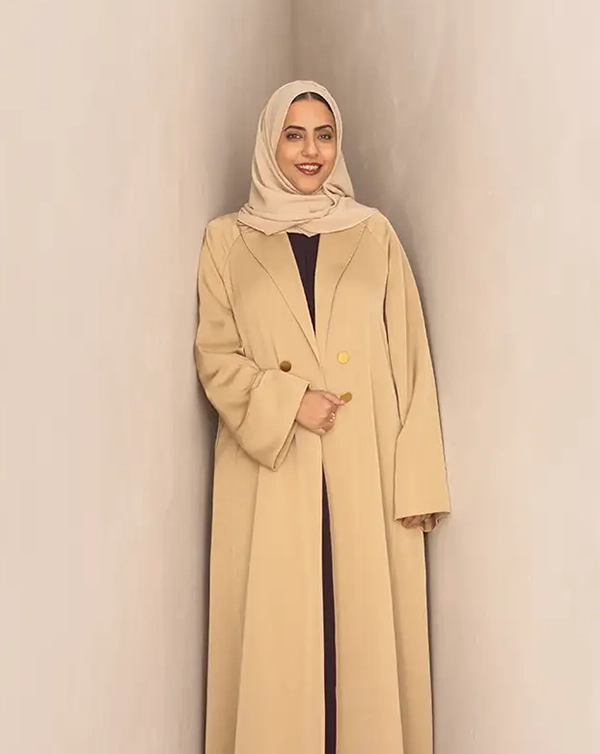
Born to Iraqi parents in 1993, Alrai grew up in Scotland. Cut off from an Arab community, she began creating fabricated or imagined artefacts as a way of exploring her heritage. Descended from the Marsh Arabs, historically rooted in the wetlands surrounding the Tigris and Euphrates rivers, she reflected in her early work on the traces left by lost cultures, from physical remnants to oral histories. “I’ve always been interested in debris and in the things that are left behind; the detritus of time,” she says.
After graduating with a fine art degree from the University of Leeds, she worked concurrently as an artist and a museum registrar, developing a fascination with the imperfect objects kept locked away in storage, marked with the traces of their lives before acquisition, yet frozen in time, “preserved at the moment they began to disappear.”
Today, she frequently employs museological structures such as partition walls, vitrines, and metal armatures in her exhibitions, provoking reflection on “the architecture of possession and ownership.” By mimicking the fragmented museological staging of objects that have been removed from their original landscapes, cut off from the cultures and rituals that gave them meaning, her artificial artefacts reflect “these stories that are also severed and amputated, broken and re-fused together.”
From intimate vessels to monumental sculptures, her installations evoke a sense of familiarity, conjuring vanished civilisations. Sketches of animal-like forms or arcane symbols hint at undisclosed mythologies. Existing outside fixed places or timelines, they become invitations to imagine. “I think that’s where there is freedom, and power,” she says. “It becomes a spot where you’re able to draw on yourself, and then actually maybe it’s not about these objects. It’s about us as people. What are our histories, why are they important, and why do they ground us?”
The Design Doha Biennale, opening in April, will include Alrai’s first exhibition in the region. Inspired by Qatar’s history of gypsum mining and the raw beauty of the Umm Bab clay quarry, her installation will feature an inversion of her usual practice. Instead of turning waste materials into seemingly priceless artefacts, she plans to work with bronze for the first time, transfiguring the metal to resemble humbler materials like leather and ceramic. Integrating local resources, including plaster and clay, she plans to create amphora and date jars, a nod to her Iraqi roots.