THE TASTE OF MEMORY

THE TASTE OF MEMORY

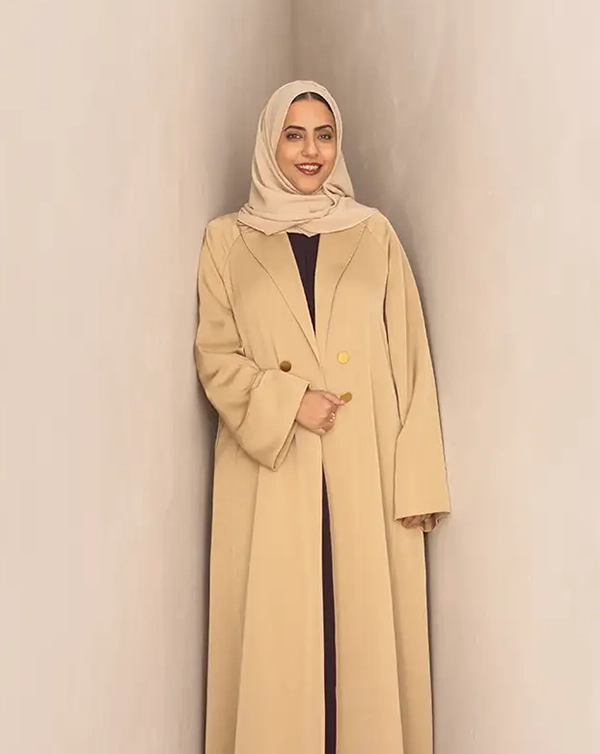
Sahar Parham Al Awadhi prepares to launch her first restaurant, with a touch of magic.

By Michelle Wranik-Hicks

PHOTOGRAPHS BY ANNA NIELSEN

Dusk settles gently over the spice souk in Deira, the narrow lanes a pointillist spectrum of colour and texture—rose petals spilling from burlap sacks, baskets of dried lime and spices, soft mounds of fragrant herbal tea. In a small store on one of the tangled alleys, Emirati chef Sahar Parham Al Awadhi is deep in conversation with an Iranian vendor. Around us, shelves are stacked floor to ceiling with jars, brass canisters and powdered resins and roots.

Al Awadhi moves instinctively, pointing out her preferred Iranian rosewater, a sticky nigella-seed oil she takes every day, her favourite Indian cardamom. “Smell this,” she says, lifting it to my nose. Inside a tiny shop, she examines Super Negin A+ premium saffron threads, deep red and slightly glossy. “The trick with saffron is you have to grind it,” she explains. “Otherwise, you don’t get the flavour or the aroma, you’re really wasting the saffron.”

Here, among the scents, tastes, and patina of old Dubai, the foundations of her cooking were set. Before the Burj Al Arab, before the accolades, this was the sensory world that shaped her palate. Here, the pull of memory is palpable. “The things that make me nostalgic are always connected to what I ate growing up,” she says.

Al Awadhi grew up nearby, in Al Muraqqabat. Her father owned a shop in Al Ghurair Centre—a universe for many Dubai kids of the 1980s and ’90s. There was Chips Oman and Laban Up after school. Choki Choki straight from the tube. The city’s first McDonald’s opening in Al Ghurair, “a huge thing at the time,” she laughs.

When the family later moved to Mirdif, then a quiet suburb, her interest in baking took hold.

Al Awadhi moves instinctively through the narrow lanes of the spice souk in Deira, pointing out her preferred suppliers. It is here that the foundations of her cooking were set.

At home, the kitchen belonged to her mother. Mornings meant balaleet—sweet noodles, egg and spice, and afternoons carried the warm, caramel scent of rangeena—end-of-summer dates stuffed with nuts, topped with flour and slowly roasted in sugar. “I can see her pitting dates,” she says. “I can smell the cinnamon filling the house.”

Her interest deepened in the homes of her aunts, where dessert spreads anchored every gathering. She baked from Spinney’s magazines and Betty Crocker boxes, watched Food Network with near-academic dedication. When her brothers opened Wild Peeta, a shawarma restaurant, she baked brownies for their menu after days working in marketing at Zayed University.

More culinary memories unfolded outdoors. Family camping trips to Fujairah or Ras Al Khaimah meant wadis, hot springs, and a large, simmering pot of machboos. “There’s nothing like rice made on the fire,” she says. There were desert-truffle hunts after rain, her uncle reading the earth for clues; and the Friday Market rituals of corn on the cob, green mango with salt and lemon, and pink cotton candy that clung to everything.

Al Awadhi’s decision to shift from a corporate job to the culinary world was not easy for her family to accept. “It was unfamiliar for my parents,” she says.

In 2016, she joined the pastry kitchen at Burj Al Arab, the first Emirati chef to work at the renowned hotel. By 2019, she was head pastry chef, leading a team of more than 30 in a kitchen that ran day and night. In 2022, she was named Best Pastry Chef at the inaugural World’s 50 Best Awards for the Middle East and North Africa.

But alongside the discipline of pastry, Al Awadhi found purpose and passion, particularly for sustainability and inclusion. Today, as she prepares to launch her first restaurant—called Abra—she sees it as the culmination of everything she values. “It wasn’t intentional,” she says, “but Abra ended up being almost entirely women-led.”

Al Awadhi is at the helm as chef-owner. Two female designers are crafting the interior. A studio run by women is creating the branding. Emirati artisans are designing the tableware with RAK Ceramics. Tashkeel is making the cutlery. Furniture is being sourced from homegrown makers.

“Locality, for us, isn’t only about ingredients,” she says. Set in Union House—where the nation was founded in 1971, and now part of the Etihad Museum—Abra is a made-in-UAE restaurant built on UAE talent.

The name carries its own symbolism. “In Arabic, Abra means ‘to cross’,” she says. “For the restaurant, it means crossing from [traditional] cuisine to new Emirati cuisine.” It not only calls to mind the wooden water taxis that line the creek (called abra), but also her nickname. “One of my friends calls me ‘magic’, because Sahar can be read as ‘sihr’ in Arabic. And what is magic? It’s abracadabra.”

Asked about modern Emirati cuisine, Al Awadhi doesn’t pause. “I don’t like fusion,” she says. “It dilutes the essence of Emirati flavours.” Her approach is evolution—dishes that adapt to a changing world. “I don’t believe cuisines are finite,” she says. “They can be infinite, especially as ingredients change or are introduced. The tomato didn’t exist in Italy once.”

While the menu is still being finalised, at Abra, diners can expect some classic Emirati dishes—perhaps salona (an aromatic Emirati stew), thareed (a crispy flatbread layered with a meat soup), harees (a creamy wheat and meat dish, topped with ghee), or arseeyah (chicken, rice and spices). Prepared with a contemporary approach, the dishes will preserve their identity. “It’s about maintaining the soul of the dish,” she says. “And elevating it through technique.”

Her previous interpretations have followed this principle. As a child, she loathed Umm Ali, a cloying bread-and-butter-pudding-style dessert often served at weddings. Her chilled, deconstructed version served at Burj Al Arab, Umm Ali 2.0—with rose mousse, salted pistachio sponge, toffee in place of raisins, and caramelised white chocolate—gained admiration. Recognisable, yet transformed.

Later, as we make our way back to Dubai Creek, the evening prayer sounds, and abras knock gently against the jetty. We board one, settling on the wooden bench as the boatman pushes off into the darkening water. Al Awadhi smiles, recalling her last day at her university job, just before she entered her first professional kitchen. She came to the creek with friends, crossed the water just as we are doing now, unaware of how much her life was about to change. “It feels like I’ve come full circle,” she says.      

Zeen is a next generation WordPress theme. It’s powerful, beautifully designed and comes with everything you need to engage your visitors and increase conversions.

Join the Hadara Community

Hadara Magazine spotlights the intersection of arts, culture, and business innovation—celebrating creativity, leadership, and visionary stories shaping the future of Arabic excellence.